📊 Overview
The ARM mobile Linux landscape has matured significantly through 2025–2026. Two fundamentally different approaches exist: mainline kernel distributions (postmarketOS, Mobian, Manjaro) build against upstream Linux, while Halium‑based distributions (Ubuntu Touch, Droidian) reuse Android vendor kernels for better hardware support at the cost of older, potentially insecure kernels. The table below summarizes each OS and its approach.
| OS | Base | Kernel | Latest | UI Options | Maturity | Daily Driver? |
|---|---|---|---|---|---|---|
| postmarketOS | Alpine Linux | Mainline | v26.06 (Jun 2026) | Phosh, Plasma Mobile, Sxmo, GNOME | Alpha/Beta | ⚠️ On best devices only |
| Ubuntu Touch | Ubuntu 24.04 | Halium (Android) | 24.04-2.0 (2026) | Lomiri (Mir/Wayland) | Stable | ✅ Yes (promoted devices) |
| Mobian | Debian 13 "Trixie" | Mainline | 13.0 (Oct 2025) | Phosh, Plasma Mobile | Stable | ⚠️ Close on best devices |
| Manjaro ARM | Arch Linux | Mainline | Beta 36 (Jan 2025) | Phosh, Plasma Mobile | Beta | ❌ No |
| DanctNIX | Arch Linux ARM | Mainline | Dec 2024 | Phosh, Plasma Mobile, Sxmo | Community Stable | ✅ PinePhone Pro reported |
| Sailfish OS | Mer (RPM-based) | Hybrid (AOSP) | 5.0 "Tampella" (Feb 2025) | Silica (proprietary) | Commercial | ✅ Yes (mature devices) |
| PureOS | Debian 12 | Mainline | Crimson Beta (Oct 2025) | Phosh | Beta | ❌ No (missed calls/crashes) |
| Droidian | Debian | Halium (Android) | 100 (2025) | Phosh | Stable | ✅ Yes (best devices) |
| FuriOS | Debian Trixie | Halium (v4.19) | Monthly updates | GNOME/Phosh | Commercial | ✅ Best overall experience |
| Kali NetHunter | Android + chroot | Android vendor | 2025.3 (Sep 2025) | Android + KDE/Xfce | Mature | 🔧 Pentesting only |
| Maemo Leste | Devuan | Mainline | Rolling | Hildon, Xfce | Experimental | ❌ No |
🗂️ Operating System Details
🔵 postmarketOS
Alpine Linux-based. Mainline kernel focus. 6‑month release cycle. ~65 devices with pre‑built images, ~723 with some level of support. Started 2017. Key 2026 milestones: systemd migration, Duranium immutable variant, generic mainline kernel initiative.
Best-Supported Devices (Community tier)
| Device | Year | SoC | RAM | Display | Calls | SMS | Data | WiFi | BT | GPS | Cam | Battery | Overall |
|---|---|---|---|---|---|---|---|---|---|---|---|---|---|
| PINE64 PinePhone | 2020 | Allwinner A64 | 2–3 GB | 5.95" 720×1440 | ✓ | ✓ | ✓ | ✓ | ✓ | Weak | Rear only | Poor | Daily-driveable |
| PINE64 PinePhone Pro | 2021 | RK3399S | 4 GB | 5.95" 720×1440 | Echo | ✓ | ✓ | ✓ | 3–4h then drops | ✓ | ✗ | 8h, no deep sleep | Not daily-driver |
| Purism Librem 5 | 2020 | i.MX 8M Quad | 3 GB | 5.7" 720×1440 | VoLTE ✓ | ✓ | ✓ | ✓ | Unreliable | Laggy | ✓ | ~24h w/ suspend | Best Linux-first |
| OnePlus 6 (enchilada) | 2018 | SDM845 | 6–8 GB | 6.28" 1080×2280 | Needs stabilization | ✓ | ✓ | ✓ | ✓ | ✗ | Macro+selfie only | 12–29h | Good but gaps |
| OnePlus 6T (fajita) | 2018 | SDM845 | 6–8 GB | 6.41" 1080×2340 | Same as OP6 | ✓ | ✓ | ✓ | ✓ | ✗ | Same as OP6 | 12–29h | Good but gaps |
| Google Pixel 3a (sargo) | 2019 | SDM670 | 4 GB | 5.6" 1080×2220 | Partial | ✓ | ✓ | 5GHz buggy | ✓ | Partial | Color issues | Partial | Active dev |
| SHIFT SHIFT6mq | 2020 | SDM845 | 8 GB | 6.0" 1080×2160 | ✓ (q6voiced) | ✓ | ✓ | ✓ | ✓ | ✗ | ✗ | OK | Best SDM845 telephony |
| Xiaomi POCO F1 | 2018 | SDM845 | 6–8 GB | 6.18" 1080×2246 | Needs ALSA cfg | ✓ | ✓ | ✓ | Needs config | ✓ | Front: ✗ | Worse than OP6 | Sensors manual |
Other Community Devices (pre-built images available)
| Device | Year | SoC | RAM | Key Working | Key Broken |
|---|---|---|---|---|---|
| Fairphone 4 | 2021 | SDM750G | 6–8 GB | Display, WiFi, GPU, USB, storage, torch | Calls (earpiece ✗), mics, modem, GPS, camera, fingerprint, NFC, charging |
| Fairphone 5 | 2023 | QCM6490 | 8 GB | Boots; actively ported | No audio for calls; core telephony broken |
| Samsung Galaxy S III | 2012 | Exynos 4412 | 1 GB | Basic functions | Very old/slow; limited |
| Samsung Galaxy S9 | 2018 | SDM845 | 4 GB | SDM845 baseline; boots | Camera, GPS, fingerprint, sensors |
| Xiaomi Mi 9T / Redmi K20 | 2019 | SDM730 | 6 GB | SDM730 baseline | Camera, calls need work |
| Xiaomi POCO X3 NFC | 2020 | SDM732G | 6–8 GB | GPU works; Phosh | SimpleDRM crash in Phosh |
| Xiaomi Redmi 7 | 2019 | SDM632 | 2–4 GB | Display, touch, WiFi | Many sensors, camera |
| Xiaomi Mi A1 (tissot) | 2017 | SDM625 | 4 GB | MSM8953 baseline | Camera, GPS |
| Xiaomi Mi A2 Lite (daisy) | 2018 | SDM625 | 3–4 GB | MSM8953 baseline | Camera, GPS |
| Xiaomi Redmi Note 4/4X (mido) | 2017 | SDM625 | 2–4 GB | MSM8953 baseline | Camera, GPS |
| Nokia N900 | 2009 | OMAP 3430 | 256 MB | Keyboard, basic Linux | Ancient hardware |
| Motorola Moto G4 Play | 2016 | SDM410 | 2 GB | MSM8916 baseline | Camera, sensors |
| Motorola Moto G5 Plus | 2017 | SDM625 | 2–4 GB | MSM8953 baseline | Camera, sensors |
| Lenovo ThinkPad X13s | 2022 | 8cx Gen 3 | 8+ GB | ARM laptop support | Some laptop functions |
Key Known Issues (postmarketOS)
- 📷 Cameras: The single biggest gap. Most devices have no working camera. Even on OnePlus 6/Pixel 3a, quality is poor.
- 📞 VoLTE: Not working on most ports. Critical blocker for countries where 3G/2G is shut down.
- 📍 GPS: No turn-by-turn navigation. Lag makes it unusable for driving.
- 🔋 Battery: Deep sleep broken on many devices. PinePhone Pro gets ~8 hours. Idle drain high.
- 🎮 GPU: Freedreno/Panfrost/Etnaviv drivers still lag behind proprietary alternatives in performance.
- 📱 Modern devices: No Tensor-based Pixels (6/7/8/9) — closed firmware blocks mainline. Most recommended devices are 5+ years old.
- 🔄 Regressions: Kernel updates frequently break things (cameras on PPP since 6.1→6.6, WiFi on PPP 6.18 broken).
🟠 Ubuntu Touch (UBports)
Ubuntu 24.04 base, Lomiri shell on Mir/Wayland. Halium-based (reuses Android kernels). 25+ promoted devices. Most polished phone-like UX of all Linux alternatives. Just completed multi-year migration from 16.04→24.04.
Promoted Devices (best support)
| Device | Year | SoC | RAM | Port % | Key Broken |
|---|---|---|---|---|---|
| Fairphone 5 ⭐ | 2023 | QCM6490 | 6–8 GB | 97.4% | VoLTE, slow GPS first fix |
| Fairphone 4 | 2021 | SDM750G | 6–8 GB | 97.3% | VoLTE, slow GPS first fix, Waydroid HDMI crash |
| OnePlus Nord N100 | 2020 | SDM460 | 4 GB | 97.3% | VoLTE, slow GPS first fix |
| Volla Phone 22 | 2022 | Helio G85 | 4 GB | 94.8% | VoLTE, wireless ext monitor |
| Volla Phone Quintus | 2024 | Dimensity 7050 | 8 GB | 93% | Fingerprint, FM radio, VoLTE partial |
| Volla Tablet | 2024 | Helio G99 | 12 GB | 92% | VoLTE untested, trackpad position delay |
Other Highly-Mature Ports (90%+)
| Device | Year | SoC | RAM | Port % | Key Broken |
|---|---|---|---|---|---|
| Google Pixel 3a | 2019 | SDM670 | 4 GB | 97.3% | VoLTE, slow GPS first fix |
| Google Pixel 3a XL | 2019 | SDM670 | 4 GB | 97.3% | VoLTE, slow GPS first fix |
| OnePlus Nord N10 5G | 2020 | SDM690 | 6 GB | 97.4% | VoLTE, slow GPS first fix |
| Xiaomi POCO X3 NFC | 2020 | SDM732G | 6 GB | 97.4% | VoLTE, slow GPS first fix |
| Xiaomi Redmi Note 9S/Pro | 2020 | SDM720G | 4–6 GB | 97.4% | VoLTE, slow GPS first fix |
| Lenovo Tab M10 HD 2nd Gen WiFi | 2021 | Helio P22T | 4 GB | 100% | VoLTE (LTE variant only) |
| Nothing Phone (1) | 2022 | SDM778G+ | 8–12 GB | 95.6% | Fingerprint, wireless ext monitor |
| JingPad A1 | 2021 | ARM | — | 97.6% | EOL hardware |
| OnePlus 6 | 2018 | SDM845 | 6–8 GB | 93.8% | Fingerprint, VoLTE, idle drain |
| OnePlus 6T | 2018 | SDM845 | 6–8 GB | 93.8% | Fingerprint, VoLTE, idle drain |
| F(x)tec Pro1 X | 2022 | SDM662 | 6–8 GB | 91.2% | Offline charging, fingerprint, VoLTE |
| Xiaomi Mi A2 | 2018 | SDM660 | 4–6 GB | 96.4% | VoLTE, slow GPS |
| Volla Phone | 2020 | Helio P23 | 4 GB | 90.4% | VoLTE, BT partial, wireless ext monitor |
| Volla Phone X23 | 2023 | Helio G99 | 6 GB | 91.4% | Fingerprint, notification LED, FM radio |
| Asus Zenfone Max Pro M1 | 2018 | SDM636 | 3–6 GB | 95.7% | VoLTE, slow GPS |
Native Linux Devices (no Halium)
| Device | Year | SoC | RAM | Port % | Key Broken |
|---|---|---|---|---|---|
| PinePhone | 2019 | Allwinner A64 | 2–3 GB | 67.3% | Camera, SIM PIN, offline charging, auto-brightness, proximity, 24h+ battery |
| PinePhone Pro | 2021 | RK3399S | 4 GB | 69% | Camera, SIM PIN, offline charging, 24h+ battery |
| PineTab / PineTab2 | 2019/2023 | A64 / RK3566 | 2–8 GB | 66.9% | Camera, battery, sensors |
Key Known Issues (Ubuntu Touch)
- 📞 VoLTE: Experimental only. Single biggest blocker for countries with 3G shutdown.
- 📍 GPS slow first fix: No AGPS support. Can take minutes for initial location lock.
- 🤖 Waydroid battery drain: Severe when Android container is active. Banking apps fail (SafetyNet).
- 📱 App ecosystem: No banking, ride-sharing, MS Teams, Slack. Web apps are the workaround.
- 🔒 Security: Halium devices use EOL Android kernels that may not receive security patches.
- 🔧 Immutable rootfs: Read-only filesystem limits customization; unlocks reset on OTA updates.
- 🖥️ Convergence: Only single external monitor; no multi-monitor; external touchscreen mapping broken.
- 📲 Notifications: Unreliable, especially cross-Waydroid. MMS buggy (WiFi must be off).
🔴 Mobian (Debian for Mobile)
Debian 13 "Trixie" with kernel 6.12. Two DE variants: Phosh 46 and KDE Plasma Mobile 6.3. 8 devices fully supported as "stable." Benefits from Debian's massive package repository and standard apt tooling.
Supported Devices
| Device | Year | SoC | RAM | Calls | SMS | Data | WiFi | GPS | Cam | Battery | Overall |
|---|---|---|---|---|---|---|---|---|---|---|---|
| PinePhone | 2019 | Allwinner A64 | 2–3 GB | Quiet audio | No MMS | ✓ | 2.4GHz only | Weak | Stills only | Poor | Basic phone |
| PinePhone Pro | 2021 | RK3399 | 4 GB | Underwater/echo | Mostly | ✓ | ✓ | Fast, indoors | Green tint | 1–3h heavy | Achilles' heel |
| OnePlus 6/6T | 2018 | SDM845 | 6–8 GB | 1-way audio, VoLTE | ✓ | ✓ | ✓ | 2-sec lock! | Macro+selfie only | 12–29h | Close to daily |
| Poco F1 (beryllium) | 2018 | SDM845 | 6–8 GB | Needs config | ✓ | ✓ | ✓ | ✓ | Front ✗ | USB OTG ✗ | Needs tinkering |
| Pixel 3a | 2019 | SDM670 | 4 GB | Call audio OK | ✓ | ✓ | 5GHz buggy | ✗ | Front buggy | All sensors ✗ | No installer |
| Librem 5 | 2020 | i.MX 8M Quad | 3 GB | Silent disconnects | No MMS | T-Mobile | ✓ | Hit-or-miss | No autofocus | ~24h suspend | Unreliable |
| PineTab | 2019 | Allwinner A64 | 2 GB | N/A | N/A | WiFi only | 2.4GHz only | Weak | Stills only | Limited RAM | Basic tablet |
🟢 Manjaro ARM (Mobile)
Arch-based rolling release. Phosh edition updated frequently (Beta 36, Jan 2025); Plasma Mobile lags (Beta 15, May 2024). Supports PinePhone, PinePhone Pro, and PineTab. Hardware status mirrors mainline kernel — same device limitations as pmOS/Mobian.
⚫ Sailfish OS
Linux-based (Mer core) with proprietary Silica UI. Commercial product by Jolla (Finland). Android AppSupport layer (Android 13 in v5.0). Current: Sailfish OS 5.0 "Tampella" (Feb 2025).
Officially Supported Devices
| Device | Year | SoC | RAM | SFOS 5.0 | Key Broken |
|---|---|---|---|---|---|
| Jolla C2 | 2025 | — | — | ✅ Reference | Current flagship; license included |
| Sony Xperia 10 V | 2023 | SDM695 | 6 GB | ✅ (beta quality) | Camera completely broken! Mobile data drops, headphone jack ✗, 50–80mA idle, eSIM ✗, BlueBinder CPU spikes |
| Sony Xperia 10 IV | 2022 | SDM695 | 6 GB | ✅ (beta quality) | Camera completely broken! Same poor connectivity/power as 10 V |
| Sony Xperia 10 III | 2021 | SDM690 | 6 GB | ✅ | Camera works but very slow focus; GPS takes minutes; battery degraded |
| Sony Xperia 10 II | 2020 | SDM665 | 4 GB | ✅ Mature, stable | GPS slow (minutes) |
| Sony Xperia 10 / 10 Plus | 2019 | SDM630 | 3–4 GB | ✅ Mature, stable | GPS slow |
| Sony Xperia XA2 family | 2018 | SDM630 | 3 GB | ✅ Mature, stable | GPS slow (minutes for lock) |
Community Ports (no license, no Android AppSupport)
| Device | Status | Key Broken |
|---|---|---|
| Redmi Note 8 (ginkgo) | Active, Aug 2025 | Most HW working |
| Redmi Note 9 Pro (miatoll) | Active, Aug 2025 | "Full feature" |
| Fairphone 4 | Alpha2 (Apr 2025) | SMS provider issues, BT reconnection, no Android apps |
| Fairphone 5 | Alpha2 (Apr 2025) | WiFi WPA2/WPA3 mixed mode ✗, no Android apps |
| OnePlus 6/6T | Community | 2G ✗, flash unreliable, fingerprint lost on reboot |
Key Known Issues (Sailfish OS)
- 📷 Camera on Xperia 10 IV/V: Completely non-functional. Community frustrated — Jolla promised commercial support by Aug 2024 that never materialized.
- 📍 GPS: Takes several minutes for a lock on every Xperia model since XA2.
- 🔋 Power: Xperia 10 V: 50–80 mA idle draw, BlueBinder consumes 700–1000 mA, battery degradation.
- 📞 VoLTE: Hit-or-miss depending on carrier.
- 💸 License cost: Official Sailfish OS requires a paid license. Community ports lack Android AppSupport and Exchange.
⚪ PureOS (Purism)
Debian-based. Two branches: Byzantium (stable, Debian 11) and Crimson (beta, Debian 12). Exclusive to Librem 5 hardware. Some users report Mobian or pmOS runs better on Librem 5 than PureOS itself.
Key Broken (Crimson Beta):
- 📞 Cellular reliability: Phone silently loses connection with no indication. Critical failure.
- 📷 Camera: No auto-focus, auto-exposure, or white balance. Third-party apps can't access it.
- 🔊 Audio (Crimson): PipeWire migration incomplete; HiFi ALSA profile broken.
- 🔋 Battery: ~24h with suspend / 4–5h without. Random shutdowns 2–3×/week.
- 🐌 Performance: i.MX 8M Quad comparable to phones from "well over ten years ago."
- 🔀 Unit variance: Two identical Evergreen units can behave very differently.
🟣 Droidian (Halium/Debian)
Debian-based using Halium + libhybris. Leverages Android vendor kernels for excellent hardware compatibility. Originally forked from Mobian. Supports Waydroid and Flatpak. Version 100 released 2025.
Officially Supported (v100)
| Device | Year | SoC | RAM | Notes |
|---|---|---|---|---|
| Google Pixel 3a/3a XL | 2019 | SDM670 | 4 GB | Nearly fully optimized; best-supported |
| Motorola ThinkPhone (bronco) | 2023 | 8+ Gen 1 | 8+ GB | Recent flagship SoC |
| FuriLabs FLX1 | 2024 | Dimensity 900 | 6 GB | Purpose-built; excellent support |
| Volla Phone | 2020 | Helio P23 | 4 GB | Dedicated Linux phone vendor |
| Xiaomi Poco M2 Pro / RN9 Pro | 2020 | SDM720G | 4–6 GB | Budget option |
| Fxtec Pro1 | 2019 | SDM835 | 6 GB | Physical keyboard slider |
| Sony Xperia 5 | 2019 | SDM855 | 6 GB | Compact flagship |
🔷 DanctNIX (Arch Linux ARM for Mobile)
Community-maintained Arch Linux ARM for Pine64 devices. The de facto Arch mobile option. PineTab 2 ships with it preloaded. PinePhone Pro reported as daily-driver in 2025 (calls, VoLTE, SMS, MMS, GPS, WiFi, 4G, hotspot all functional).
Supported Devices
| Device | Status | UI Options |
|---|---|---|
| PinePhone | Actively maintained (last: Mar 2024) | Phosh, Plasma Mobile, Sxmo, barebones |
| PinePhone Pro | Daily-drivable (Jan 2025 reports) | Phosh, Plasma Mobile, Sxmo, barebones |
| PineTab | Supported; Phosh, mainline kernel | Phosh |
| PineTab 2 | Ships with DanctNIX preloaded (RK3566) | Phosh (default) |
🔶 Other Notable Distributions
FuriOS (FuriLabs FLX1)
Purpose-built Debian phone. Widely regarded as the most usable Linux phone available.
| Model | Year | SoC | RAM | Battery | Price | Key Features |
|---|---|---|---|---|---|---|
| FLX1 | 2024 | Dimensity 900 | 6 GB | 5000 mAh removable | $499–550 | 6.6" 120Hz IPS, 50MP camera, IP68 |
| FLX1s | 2025 | Dimensity 900 | 8 GB | 5000 mAh removable | $550 | 6.7" 90Hz, 3 hardware killswitches, KVM, multi-boot |
⚠️ Drawbacks: EOL vendor kernel 4.19, no USB-C DP out, no swipe keyboard, second SIM not initially supported.
Kali NetHunter
Mobile pentesting platform (Android + chroot). Best devices: Pixel 4a/5/6, OnePlus 7/7T/8/8T, Poco F1/X3 Pro. Requires: unlocked bootloader, TWRP, Magisk root, LineageOS base. Specialized niche — not a general-purpose mobile OS.
Maemo Leste
Devuan-based revival of Maemo (Nokia N900/N9 era). Hildon/Xfce UI. Supported: Nokia N900, Motorola Droid 4, PinePhone, Raspberry Pi. Experimental; active development but very niche. GPS and camera broken on most devices.
Plasma Mobile (standalone)
KDE's touch-friendly Plasma variant. Available as a UI option within postmarketOS, Mobian, Manjaro, and DanctNIX. Not distributed as a standalone OS. Best Waydroid/Android app integration of any Linux mobile UI. On-screen button navigation (back/home/overview) — the only mobile UI with this option.
NixOS Mobile
Experimental. Supports PinePhone, PinePhone Pro, and a few other devices. Reproducible builds and declarative config are unique advantages, but very early stage. Not daily-drivable.
Fedora Mobility
Fedora has a mobility SIG. Limited device support — mainly PinePhone. Very early stage compared to Debian/Alpine/Arch options.
LuneOS
webOS successor. "Eiskaffee" release Feb 2024 with Qt6 migration complete. Still alpha quality. Supports PinePhone, Nexus 4/5/7, Galaxy Nexus, Xiaomi Mi A2. Active but niche development.
Nemo Mobile / Glacier
Mer-based (same core as Sailfish OS). Healthy 2024 development with Qt6 migration. Targets Manjaro and openSUSE. Glacier is the reference UI. PinePhone is the primary device. Community-driven alternative to Sailfish OS without proprietary bits.
AsteroidOS
Linux-based OS for smartwatches. 20+ fully supported devices: TicWatch E/S/Pro, Fossil Gen 4/5, Huawei Watch, LG G Watch/Watch R/Watch Urbane, Asus ZenWatch 1/2/3, MTK6580 watches. Samsung Galaxy Watch 4 and Pixel Watch 3 ports in progress. Not a phone OS but relevant to ARM mobile Linux ecosystem.
Android-Based Alternatives (non-Linux, for comparison)
LineageOS: Android 16 (v23, Oct 2025). 100+ devices. The most mature custom ROM.
/e/OS: De-googled Android. 200+ devices. Murena phones pre-installed.
GrapheneOS: Security-hardened Android. Pixel-only (Tensor devices). Most secure mobile OS available.
CalyxOS: Privacy-focused Android. Pixels + Fairphone 4/5 + Moto G series.
These are NOT GNU/Linux distributions but offer a practical middle-ground for privacy-conscious users who need working cameras, banking apps, and reliable telephony.
🔀 Section 2: Multi‑OS Devices (Alphabetical)
Devices that can run 2 or more distinct ARM Linux distributions. Listed alphabetically with all compatible OSes and a quick status summary.
Fairphone 4 2021 SDM750G 6–8 GB
⚠️ pmOS is NOT a phone on FP4 — it's a pocket Linux computer. Ubuntu Touch is the best experience.
Fairphone 5 2023 QCM6490 6–8 GB
Ubuntu Touch is the clear winner here. Sailfish OS community port is alpha quality.
F(x)tec Pro1 2019 SDM835 6 GB
Physical landscape QWERTY keyboard. Pro1 X is the main supported variant.
Google Pixel 3a / 3a XL 2019 SDM670 4 GB
🏆 The most versatile device — runs 4 different Linux distros. UT and Droidian are most functional.
Purism Librem 5 2020 i.MX 8M Quad 3 GB
⚠️ Some users report pmOS/Mobian runs BETTER than PureOS on this hardware.
OnePlus 6 / 6T 2018 SDM845 6–8 GB
🏆 Runs FIVE different Linux distros — most versatile SDM845 device. GPS great on Mobian, calls best on UT.
PINE64 PinePhone 2019 Allwinner A64 2–3 GB
🏆 EIGHT different Linux distros. The ultimate tinkerer's phone. Not powerful but incredibly versatile.
PINE64 PinePhone Pro 2021 RK3399S 4 GB
⚠️ Discontinued by Pine64 (Aug 2025). Community mainlining continues. DanctNIX is the best experience.
Xiaomi POCO F1 (beryllium) 2018 SDM845 6–8 GB
Budget SDM845 option. Two display panel variants (tianma and ebbg) — try tianma first.
SHIFT SHIFT6mq 2020 SDM845 8 GB
German sustainability phone. SHIFT employs mainline developers. Camera + GPS are the big gaps. SHIFTphone 8 (2024, QCM6490, 12 GB RAM): announced with mainline patches submitted upstream. Next-gen upgrade.
Sony Xperia 10 III / 10 IV / 10 V 2021–2023 SDM690/695 6 GB
Active mainline development for all recent Xperia models. Sailfish OS is the primary supported option from Jolla.
Volla Phone (multiple models) 2020–2024 Various MTK 4–12 GB
Dedicated Linux phone manufacturer (Hallo Welt Systeme). Also ships with Volla OS (AOSP-based). UT experience is the best.
🏁 Quick Verdict: What Should You Actually Use?
🏆 Best Daily Driver
If you need a phone that works
FuriLabs FLX1/FLX1s with FuriOS — best overall Linux phone experience. Good battery, working camera, smooth UI, monthly updates.
Runner-up: Ubuntu Touch on Fairphone 5 — promoted, 97.4% port progress, modern hardware, removable battery.
🔧 Best for Tinkering
Maximum OS flexibility
PinePhone — runs 8 different Linux distros. Hardware killswitches. Removable battery. Cheap ($150).
Runner-up: OnePlus 6/6T — runs 5 distros, great specs (6–8 GB RAM, SDM845), found cheap used.
💻 Best Pocket Linux Computer
Not a phone, a Linux PC in your pocket
SHIFT6mq — best SDM845 telephony on pmOS. OnePlus 6 with Mobian — incredible GPS, good specs.
Pixel 3a — runs 4 distros, cheap (~$100), actively maintained everywhere.
🛡️ Best Privacy Focus
Hardware killswitches, no proprietary blobs
Librem 5 running postmarketOS — "almost everything works" per daily-driver reports in 2026. VoLTE, Signal, VPNs, FDE all functional. PureOS is less reliable.
Runner-up: PinePhone with 6 hardware killswitches.
🔵 PostmarketOS Deep Dive — Best Device, Feature Rankings & UI Options
A comprehensive analysis of which device offers the most complete postmarketOS experience, which device is the best daily driver, and what the newest viable option is. Research updated August 2026.
🏆 The Best Phone for postmarketOS Right Now: Purism Librem 5
Based on feature completeness, community reports from daily-drivers, and official pmOS support, the Librem 5 has the most features actually working on postmarketOS as of 2026. A daily-driver user reports: "Almost everything works — VoLTE calls, SMS, mobile data, camera, full disk encryption, Signal Desktop, Matrix, VPNs, Syncthing." It went from "almost nothing worked to almost everything works."
⚠️ Caveats: GPS lags at driving speeds, GPU limited (OpenGL 2.1/ES 2.0), performance is modest (i.MX 8M Quad = phone from "well over 10 years ago"), and hardware quality varies between units. But for feature completeness on pmOS specifically, nothing beats it.
📊 Device Feature Completeness Ranking (PostmarketOS)
Devices ranked by percentage of features working on postmarketOS. Scored across 25 hardware features. Working (2pts) Partial (1pt) Broken (0pts) Max score: 50.
| # | Device | Year | SoC | RAM | Score | Display | WiFi | BT | Calls | SMS | 4G | GPS | Rear Cam | Front Cam | Audio | Sensors | FP | NFC | USB OTG | Video | GPU | Battery | FDE | SD | Waydroid | Verdict |
|---|---|---|---|---|---|---|---|---|---|---|---|---|---|---|---|---|---|---|---|---|---|---|---|---|---|---|
| 🥇 1 | Purism Librem 5 | 2020 | i.MX 8M Quad | 3 GB | 44/50 | ✓ | ✓ | ~ | VoLTE | ✓ | ✓ | Laggy | ✓ | ✓ | ✓ | ✓ | — | — | ✓ | ✓ | Basic | ~24h | LUKS | ✓ | ✓ | BEST OVERALL |
| 🥈 2 | PinePhone | 2020 | Allwinner A64 | 2–3 GB | 39/50 | ✓ | ✓ | ✓ | ✓ | ✓ | ✓ | Weak | Stills | ✗ | ✓ | ✓ | — | — | ✓ | ✗ | ✓ | Poor | ✓ | ✓ | ✓ | Most mature pmOS device; cheap, versatile |
| 🥉 3 | OnePlus 6/6T | 2018 | SDM845 | 6–8 GB | 34/50 | ✓ | ✓ | ✓ | Unstable | ✓ | ✓ | ✗ | Macro only | Selfie only | Distorted | ✗ | ✗ | ✗ | ✗ | ✓ | Vulkan! | 12–29h | ✓ | — | Partial | Best hardware specs; calls the blocker |
| 4 | SHIFT SHIFT6mq | 2020 | SDM845 | 8 GB | 32/50 | ✓ | ✓ | ✓ | ✓ | ✓ | ✓ | ✗ | ✗ | ✗ | ✓ | ✓ | — | ✗ | ✗ | ✓ | ✓ | OK | ✓ | ✓ | ✓ | Best SDM845 telephony; camera/GPS gaps |
| 5 | Google Pixel 3a | 2019 | SDM670 | 4 GB | 30/50 | ✓ | 5GHz ✗ | ✓ | Partial | ✓ | ✓ | Partial | Poor color | Buggy | Partial | ✓ | ✗ | Untested | ✗ | ✓ | ✓ | Partial | ✓ | — | Partial | Active mainlining; kernel 6.18.3 |
| 6 | Xiaomi POCO F1 | 2018 | SDM845 | 6–8 GB | 28/50 | ✓ | ✓ | Needs cfg | Needs cfg | ✓ | ✓ | ✓ | WIP | ✗ | Quiet | Manual | ✓ | — | ✗ | ✓ | ✓ | Poor | Needs cfg | ✓ | Partial | Budget SDM845; front cam + USB OTG broken |
| 7 | PinePhone Pro | 2021 | RK3399S | 4 GB | 26/50 | ✓ | ✓ | 3–4h | Echo | ✓ | ✓ | ✓ | ✗ | ✗ | Echo | ✓ | — | — | ✗ | ✓ | ✓ | 8h, no sleep | ✓ | ✓ | ✓ | Discontinued; camera ✗, terrible battery |
| 8 | Fairphone 4 | 2021 | SDM750G | 6–8 GB | 20/50 | ✓ | ✓ | ? | ✗ | ✗ | ✗ | ✗ | Horrible | Horrible | Earpiece ✗ | Partial | ✗ | ✗ | Breaks after suspend | ✗ | ✓ | ✗ | ✓ | ✓ | Partial | NOT a phone on pmOS — pocket Linux PC only |
| 9 | Fairphone 5 | 2023 | QCM6490 | 6–8 GB | 15/50 | ✓ | ✓ | ? | No audio | ✗ | ✗ | ✗ | ✗ | ✗ | No audio | ? | ✗ | ✗ | ✗ | ✗ | ✓ | ? | ✓ | ✓ | ? | Very early; no telephony at all |
🔍 Detailed Analysis: Top 5 Devices
🥇 #1 — Purism Librem 5
What's working: VoLTE calls ✅, SMS ✅, mobile data ✅, WiFi ✅, rear camera ✅, front camera ✅,
FDE (LUKS) ✅, SD card ✅, USB OTG ✅, Waydroid ✅, Signal Desktop ✅, hardware kill switches ✅.
What's broken/limited: GPS lags several hundred meters at >50 km/h (no turn-by-turn nav),
Bluetooth pairing unreliable, GPU limited to OpenGL 2.1/ES 2.0 (Etnaviv driver hasn't caught up to
hardware capability), performance is "phones from 10+ years ago" territory, 3 GB RAM limits multitasking,
battery ~24h with auto-suspend / 4-5h without, unit-to-unit variability is high.
2026 community verdict: "I love it. It pisses me off sometimes, but not enough to stop loving it."
The most feature-complete pmOS device. Best for privacy maximalists willing to accept modest performance.
🥈 #2 — PinePhone
What's working: Calls ✅, SMS ✅, mobile data ✅, WiFi (2.4GHz) ✅, Bluetooth ✅,
rear camera stills ✅, GPS (weak) ✅, sensors ✅, USB OTG ✅, Waydroid ✅, SD card ✅,
6 hardware kill switches ✅, Phosh ~450 MB RAM leaving room to work.
What's broken/limited: Front camera ✗ (no mainline GC2145 driver), GPS weak (small antenna),
video recording ✗, MMS ✗, call audio too quiet, battery terrible (2800 mAh, no deep sleep without Crust),
cannot charge while suspended, Braveheart revision has drain even when "off," screen delamination
reported on some units, WiFi 2.4GHz only.
2026 community verdict: The most mature pmOS device overall. Still being sold (est. 2 more years).
Remarkably functional for $150. Best for tinkerers and as a development platform.
Definitely NOT a daily driver for non-enthusiasts.
🥉 #3 — OnePlus 6/6T
What's working: Display (OLED) ✅, GPU (OpenGL 4.x + Vulkan via Freedreno) ✅,
WiFi ✅, SMS ✅, mobile data ✅, sensors on Mobian ✅, Waydroid partially ✅,
FDE ✅, USB networking ✅, battery 12–29h (depending on suspend config) ✅.
What's broken/limited: Voice calls unreliable (earpiece audio, one-way audio, no wake from suspend),
VOIP calling works better than cellular, GPS ✗, cameras ✗ (macro + selfie partially working, primary rear ✗,
pink/green tint), NFC ✗, fingerprint ✗, USB OTG ✗, main speaker distorted, all internal sensors ✗ on pmOS.
2026 community verdict: "Excellent pocket Linux computer, bad phone." The SDM845 gives it the
best hardware specs of any pmOS device. If you can live without cellular calls and camera,
it's the fastest mobile Linux experience available. Great for SSH, coding, VPN, and Linux tasks on the go.
Used prices have gone UP due to pmOS demand.
#4 — SHIFT SHIFT6mq
What's working: Calls ✅ (via q6voiced — this is HUGE for SDM845!), SMS ✅,
mobile data ✅, WiFi ✅, Bluetooth ✅, audio (headset, speaker-left, mics) ✅,
FDE ✅, sensors (accelerometer/compass/light fixed via SDM845 sensor core RE) ✅,
GPU ✅, Waydroid ✅, DTMF tones ✅.
What's broken/limited: Camera ✗, GPS ✗, NFC ✗, USB OTG ✗, no earpiece in voice call mode,
no output switching, no mic mute, audio cuts after 5 seconds (PulseAudio suspend), speaker left channel only.
2026 community verdict: The only SDM845 device where phone calls actually work on pmOS.
SHIFT employs mainline developers. If camera and GPS were working, this would be #2 or #1.
The upcoming SHIFTphone 8 (QCM6490, 12 GB, 2024) has mainline patches already submitted.
#5 — Google Pixel 3a
What's working: Display (OLED, sleep/brightness) ✅, GPU ✅, Bluetooth ✅,
SMS ✅, mobile data ✅, FDE (via unl0kr) ✅, accelerometer/proximity/light/haptics ✅,
USB networking ✅, rear camera flash ✅, internal storage ✅.
What's broken/limited: WiFi partial (5GHz buggy), calls partial, audio partial,
rear camera lacks autofocus driver (color/saturation issues), front camera buggy,
GPS partial, NFC partial/untested, battery level/charging partial, magnetometer ✗,
USB OTG ✗, fingerprint untested, no installer images.
2026 community verdict: One of the most actively maintained devices (kernel 6.18.3).
The ONLY Pixel with community-level pmOS support (Tensor Pixels 6/7/8/9 have no mainline support due to
closed firmware). Cheap and available. Good development platform but not daily-driver.
🆕 The Newest Options for PostmarketOS
🔧 SHIFTphone 8 NEW
The most promising upcoming device for postmarketOS. SHIFT employs developers working on mainline Linux support. The QCM6490 is a Qualcomm IoT/industrial SoC with better mainline potential than consumer Snapdragons. 12 GB RAM and modern specs make it a massive upgrade over current options. Mainline patches already submitted upstream. Not yet shipping with pmOS, but the company's track record (SHIFT6mq has the best SDM845 telephony) makes this the one to watch.
📱 Fairphone 5 EARLY
Firmware packages are in the pmOS repository (Jan 2026). The device boots but has no call audio and core telephony is broken. The same QCM6490 as SHIFTphone 8. Repairable design with removable battery. At current pace, it's 1–2 years away from being pmOS-viable. For now, Ubuntu Touch is far better on this hardware.
🚀 OnePlus 6/6T (still!) BEST SPECS
Ironically, a 2018 phone is still the best-performing postmarketOS device by far. The SDM845 has the most mature mainline Linux support of any mobile SoC. Freedreno GPU driver delivers OpenGL 4.x + Vulkan — no other pmOS device comes close for graphical performance. Camera support was added in 2025 (though quality is poor). The used market price has actually increased due to pmOS demand. If call reliability improves with kernel 7.1+, this could challenge the Librem 5 for the #1 spot.
❌ What About Newer Flagships?
Short answer: None of them work with mainline Linux.
• Google Tensor (Pixel 6/7/8/9): Closed firmware, no mainline effort. The Pixel 3a (2019)
remains the ONLY Pixel with community pmOS support.
• Snapdragon 8 Gen 1/2/3: No mainline ports. Motorola ThinkPhone (8+ Gen 1) runs Droidian
via Halium (Android kernel), not mainline.
• Samsung Exynos 2200/2400: Zero mainline support.
• MediaTek Dimensity 9000+: Zero mainline support.
The SDM845 (2018) remains the newest Qualcomm SoC with mature mainline Linux support.
This is the fundamental bottleneck: mainline Linux for mobile SoCs lags 6–8 years behind hardware release.
The QCM6490 (2023, in Fairphone 5/SHIFTphone 8) is the next frontier being actively mainlined.
🎨 PostmarketOS User Interface Options
PostmarketOS is UI-agnostic. Four mobile interfaces are included in every release. Each has a distinct philosophy. Click any section to expand screenshots.
GNOME/GTK · Gesture-based · ~450 MB RAM
KDE/Qt · Button nav · Best Waydroid
Minimalist · HW buttons · Tiling WMs
GNOME Shell · Touch-adapted · New
| Feature | Phosh | Plasma Mobile | Sxmo | GNOME Mobile |
|---|---|---|---|---|
| Version in pmOS 26.06 | 0.55 | 6.6.5 (6.7 mid-cycle) | 1.18.1 | 48.mobile.0 |
| RAM usage (idle) | ~350–500 MB | ~600–900 MB | ~170 MB | ~800–1200 MB |
| Recommended min RAM | 2 GB (3 GB rec.) | 2 GB (3 GB rec.) | 512 MB (1 GB practical) | 4 GB |
| Toolkit | GTK 4 / GNOME | Qt 6 / KDE | X11 (dwm) or Wayland (Sway) | GTK 4 / GNOME Shell |
| Navigation | Swipe gestures | On-screen buttons | Hardware buttons + menus | Swipe gestures |
| Touch-friendliness | Excellent | Excellent | Minimal (by design) | Good, rough edges |
| Convergence (docking) | Seamless! | Docked Mode, WIP | N/A | Forked, not converged |
| Android apps (Waydroid) | Manual setup | First-class integration! | Manual, terminal-driven | Manual, heavy RAM contention |
| Customization | Low-Medium | Very High | Extreme (shell scripts) | Low (limited extensions) |
| Learning curve | Low | Low-Medium | Steep (terminal/Vim) | Low-Medium |
| Prebuilt images? | Yes | Yes | Yes | No (build from source) |
| Daily driver ready? | Yes (best tested) | Yes (maturing fast) | Yes (terminal users) | No (crash-prone, call audio ✗) |
| Cloud sync | Nextcloud, WebDAV, MS | Nextcloud, KDE Connect | Manual (scriptable) | Nextcloud, WebDAV |
| Init system | systemd | systemd | OpenRC (keeps) | systemd |
| Best for | Smartphone-like UX, beginners, convergence | KDE fans, Android apps, customization | Power users, minimalists, old hardware | GNOME contributors (not users yet) |
What Is Phosh?
Phosh (Phone Shell) is a mobile UI developed by Purism for the Librem 5, built on GNOME/GTK technologies. It's the most mature and widely used mobile Linux UI. Navigation is purely gesture-based: swipe up from bottom for app overview, swipe down from top for quick settings. No on-screen buttons — everything is swipes.
Convergence is where Phosh truly shines. Plug into a USB-C dock with HDMI + keyboard + mouse and it "just works" — apps resize, external display activates, and you have a desktop experience. DistroWatch (Jan 2026) called it "the first time I've encountered seamless convergence where no technical knowledge was required."
Apps are standard GTK/Libadwaita desktop apps that adapt to the small screen. The app ecosystem includes Calls, Chatty (SMS/MMS), GNOME Web (browser), Geary (email), GNOME Maps, Megapixels (camera), and all standard GNOME utilities.
Version in pmOS 26.06: 0.55 · RAM: ~450 MB on PinePhone · Source: phosh.mobi
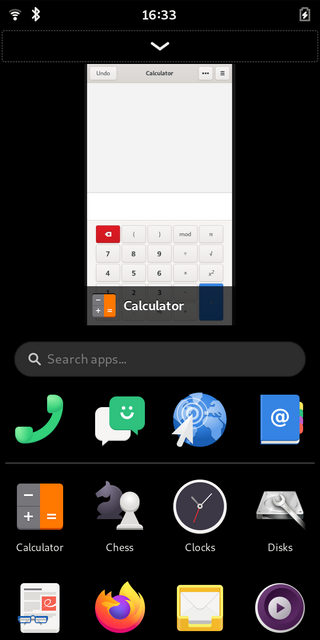
Phosh Overview — app grid with search
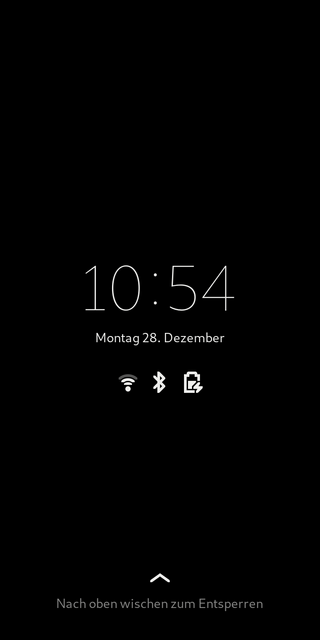
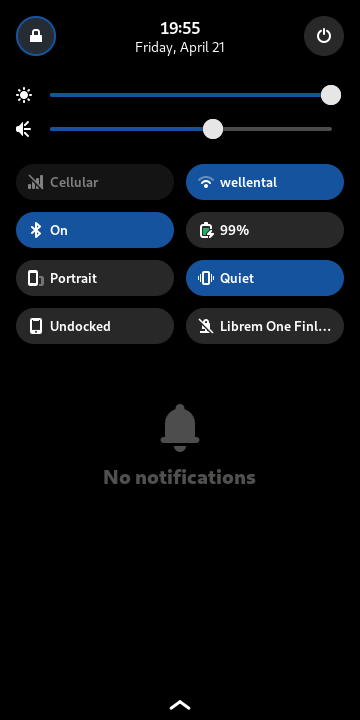
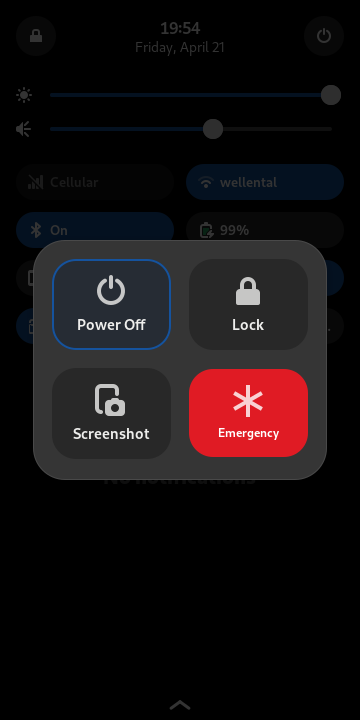
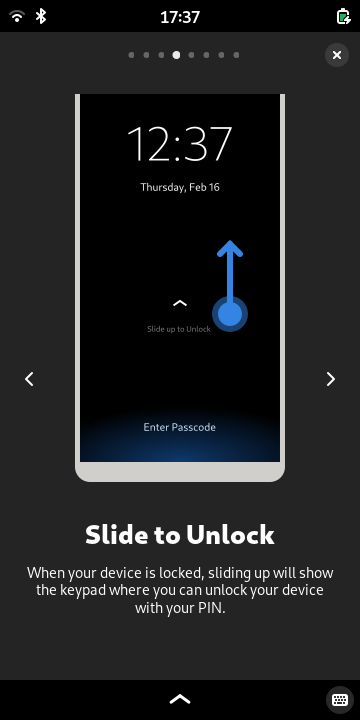
📷 Images from phosh.mobi — click to view full size
What Is Plasma Mobile?
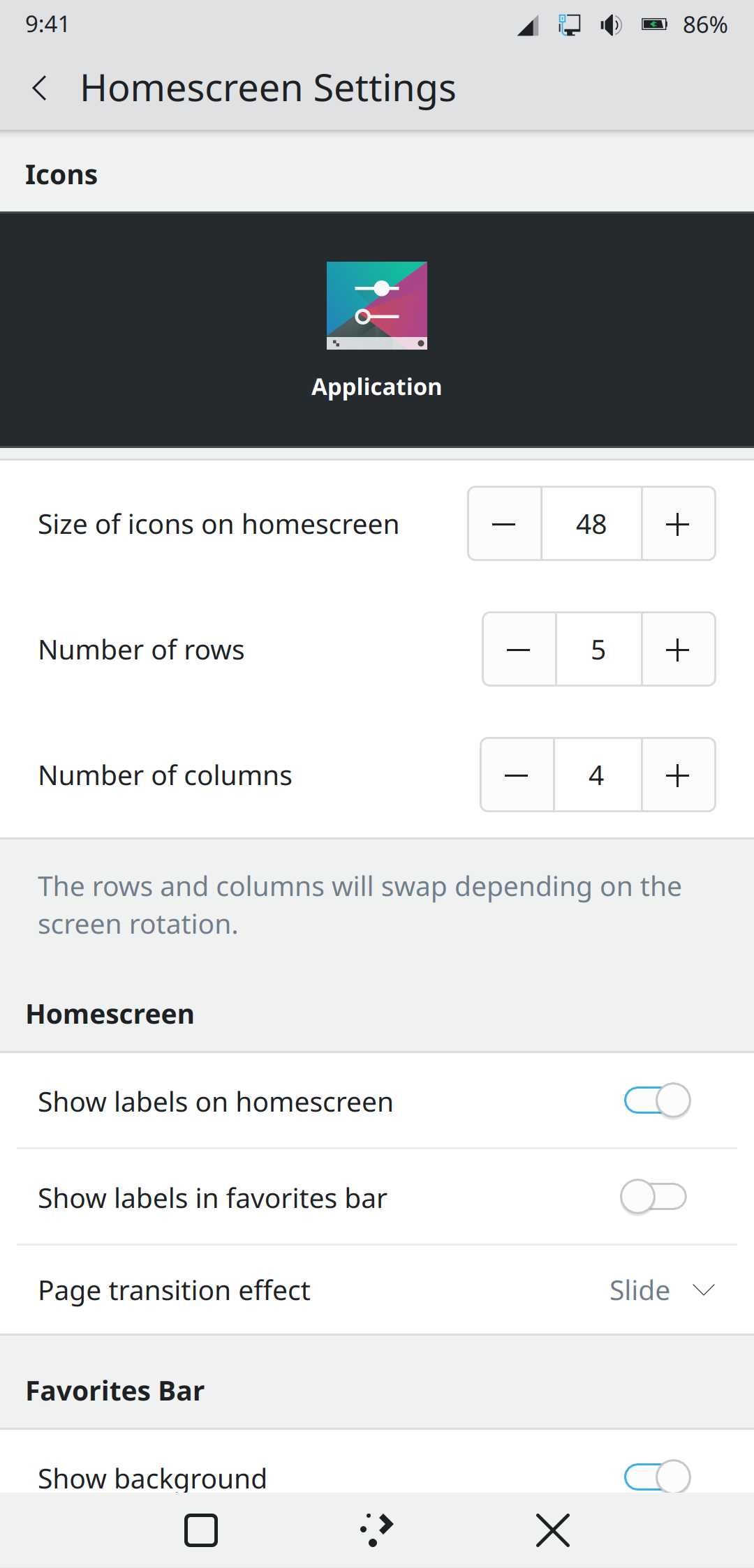
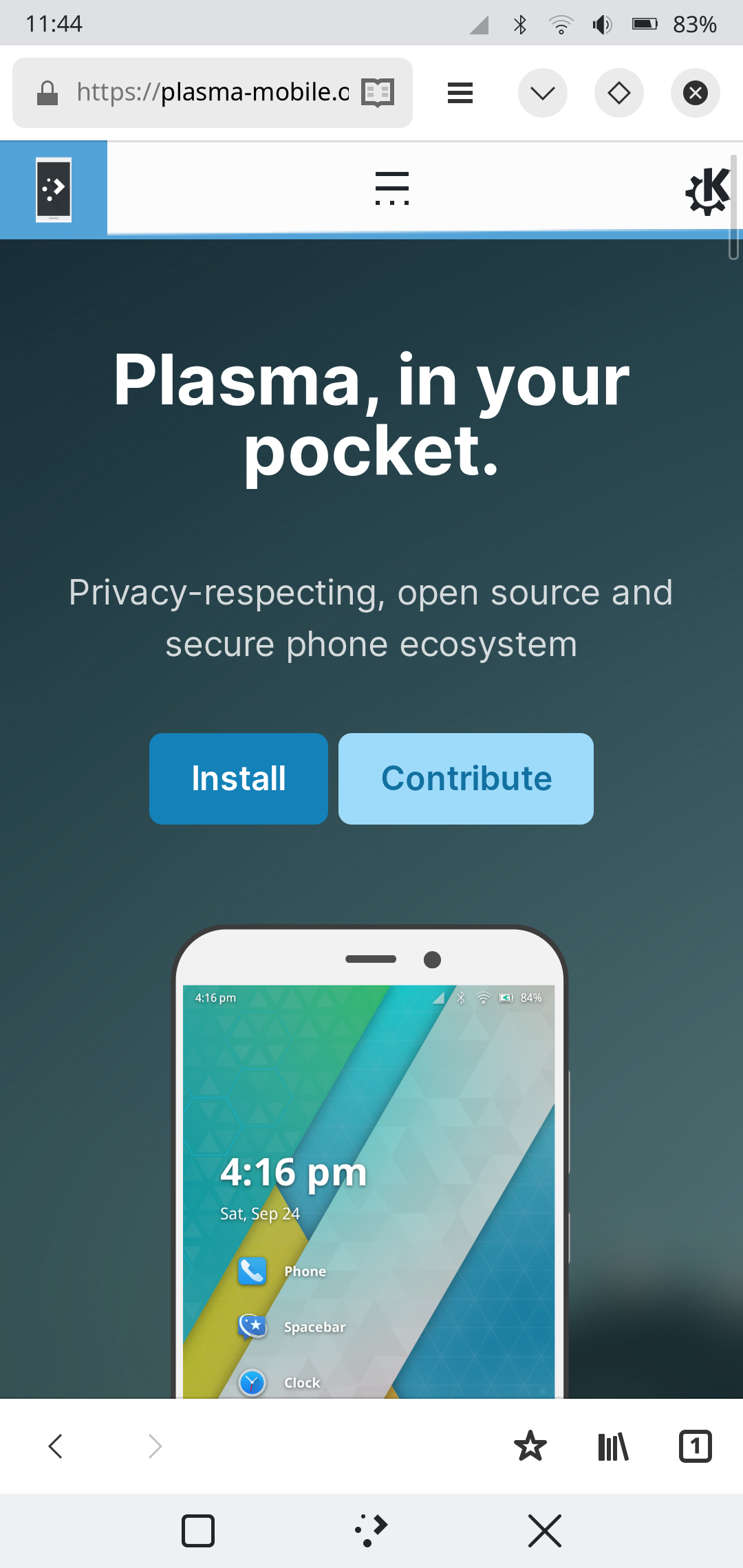
Plasma Mobile is KDE's touch-optimized mobile shell, built on Qt 6 and KDE Frameworks. It's the only mobile UI with on-screen navigation buttons (back, home, app overview) — all others use gestures. This makes it more familiar to Android users.
Waydroid integration is the best of any pmOS UI. Android apps appear alongside native Linux apps in the app drawer with near-seamless integration. If you need Android apps on your Linux phone, Plasma Mobile is the clear choice.
Widgets, customizable panels, and extensive theming make it the most visually flexible option. The desktop mode (KWin) is available but described as "slow and unstable" compared to Phosh's seamless convergence. Apps include Spacebar (SMS), KDE Connect, Angelfish (browser), Koko (photos), and the full KDE application suite.
Version in pmOS 26.06: 6.6.5 · RAM: ~600 MB · Source: plasma-mobile.org
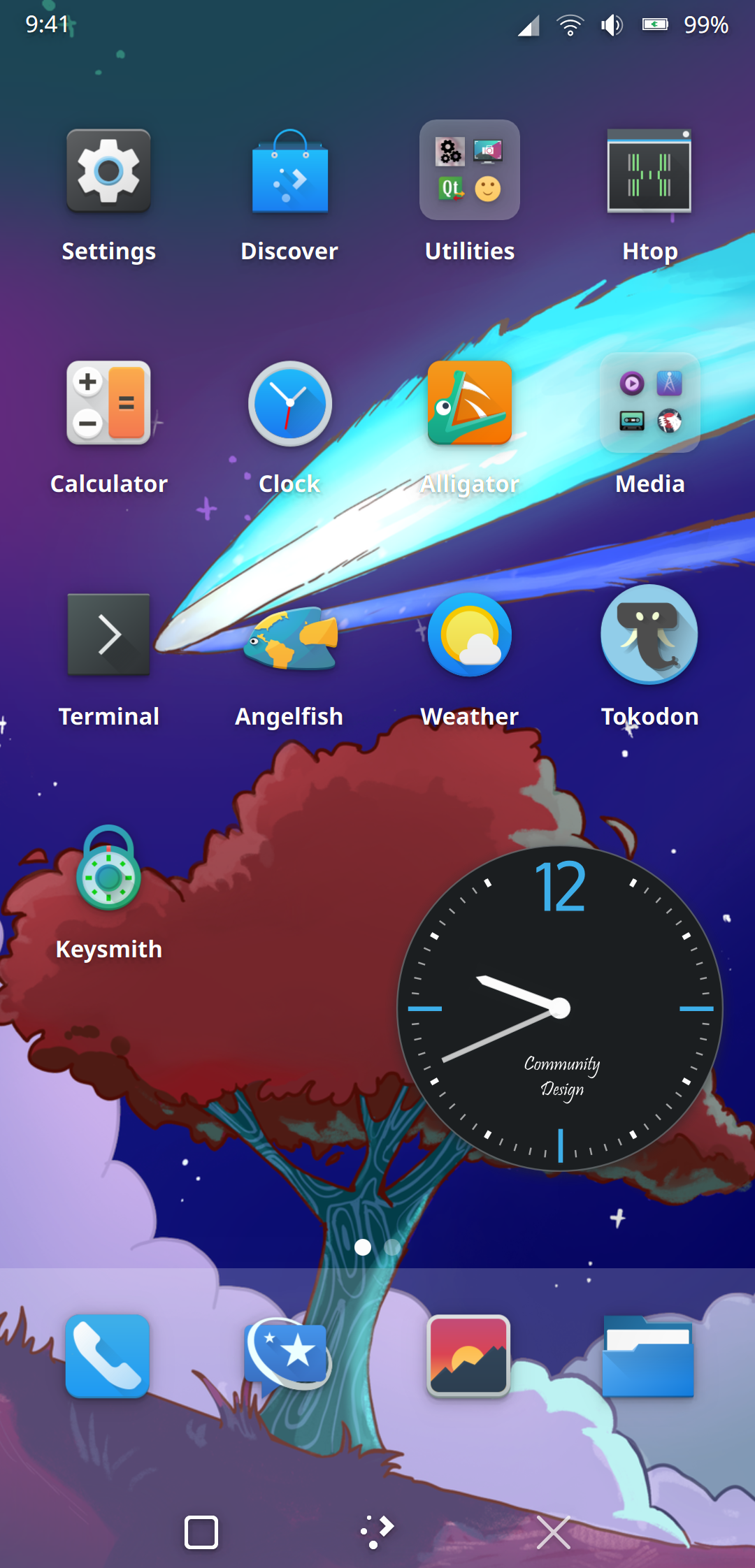
Plasma Mobile 6 Folio home screen (dark mode)
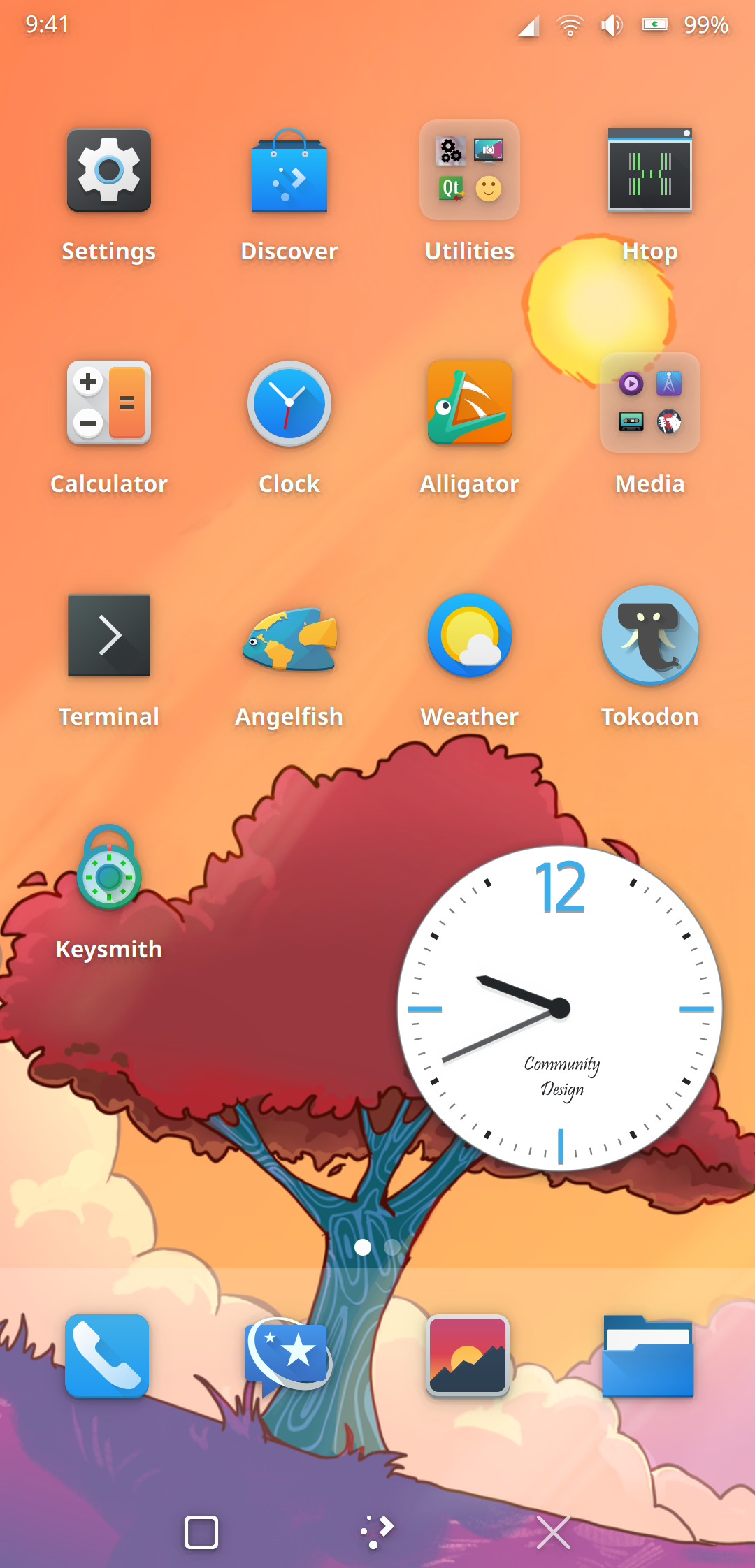
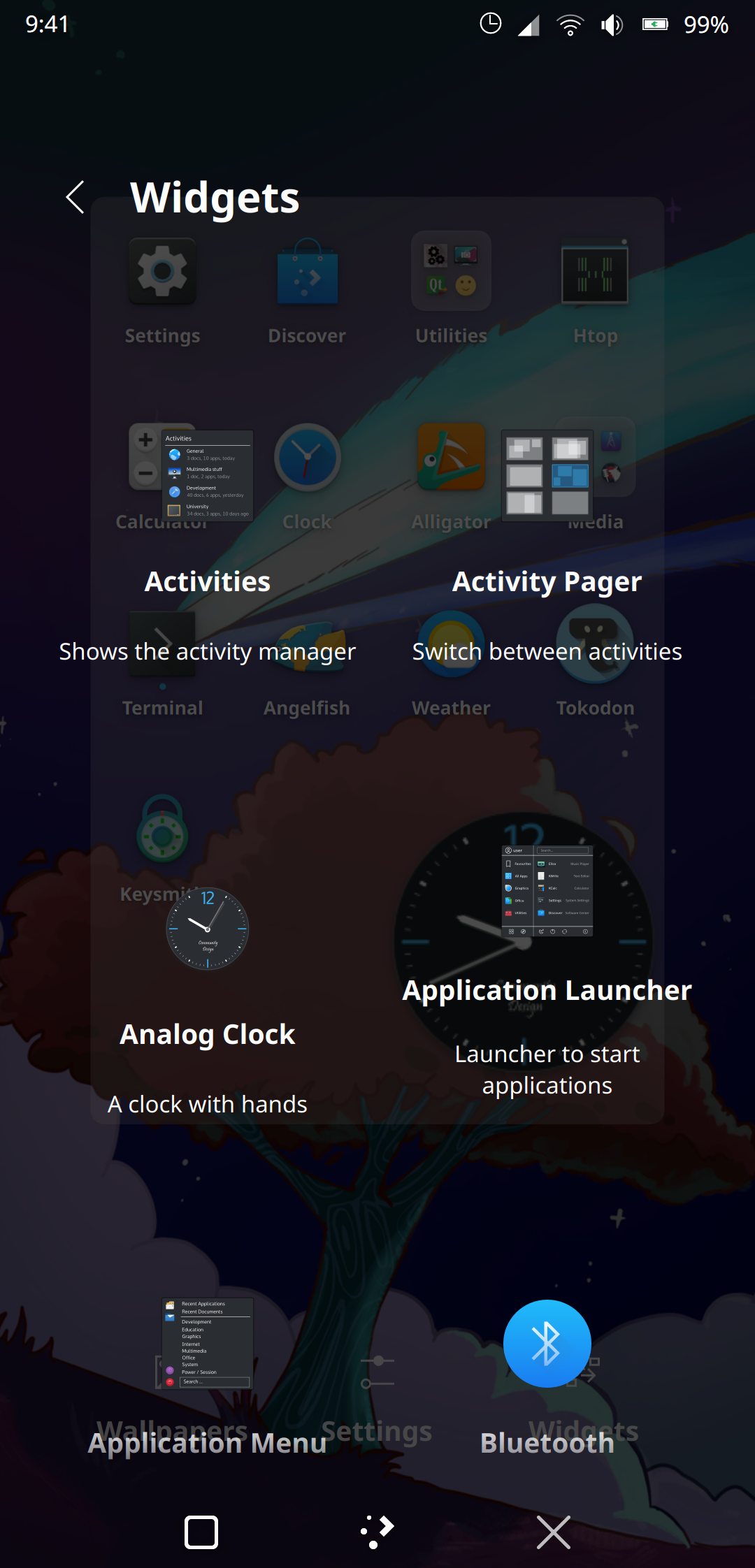
📷 Images from plasma-mobile.org — click to view full size
What Is Sxmo?
Sxmo (Simple X Mobile) is a radically minimalist UI that abandons traditional touch interactions in favor of hardware buttons and tiling window managers. It uses the volume up, volume down, and power buttons with tap sequences (single, double, triple, long-press) to trigger 9 different actions.
Two flavors: Xorg (dwm + dmenu + st terminal) and Wayland (Sway + bemenu + foot terminal). i3 and River are also supported. System menus appear as text-searchable lists via dmenu/bemenu. SMS is composed in vis (a Vim-like editor). Contacts are tab-separated text files. Everything is a shell script — completely hackable and configurable.
RAM usage is lowest of all UIs (~150 MB), making it perfect for low-spec hardware like the Nokia N900 or PinePhone with 2 GB RAM. It's the only UI that still defaults to OpenRC instead of systemd. Not for beginners — it requires comfort with the terminal, shell scripting, and Vim-like editing.
Version in pmOS 26.06: 1.18.1 · RAM: ~150 MB · Source: sxmo.org
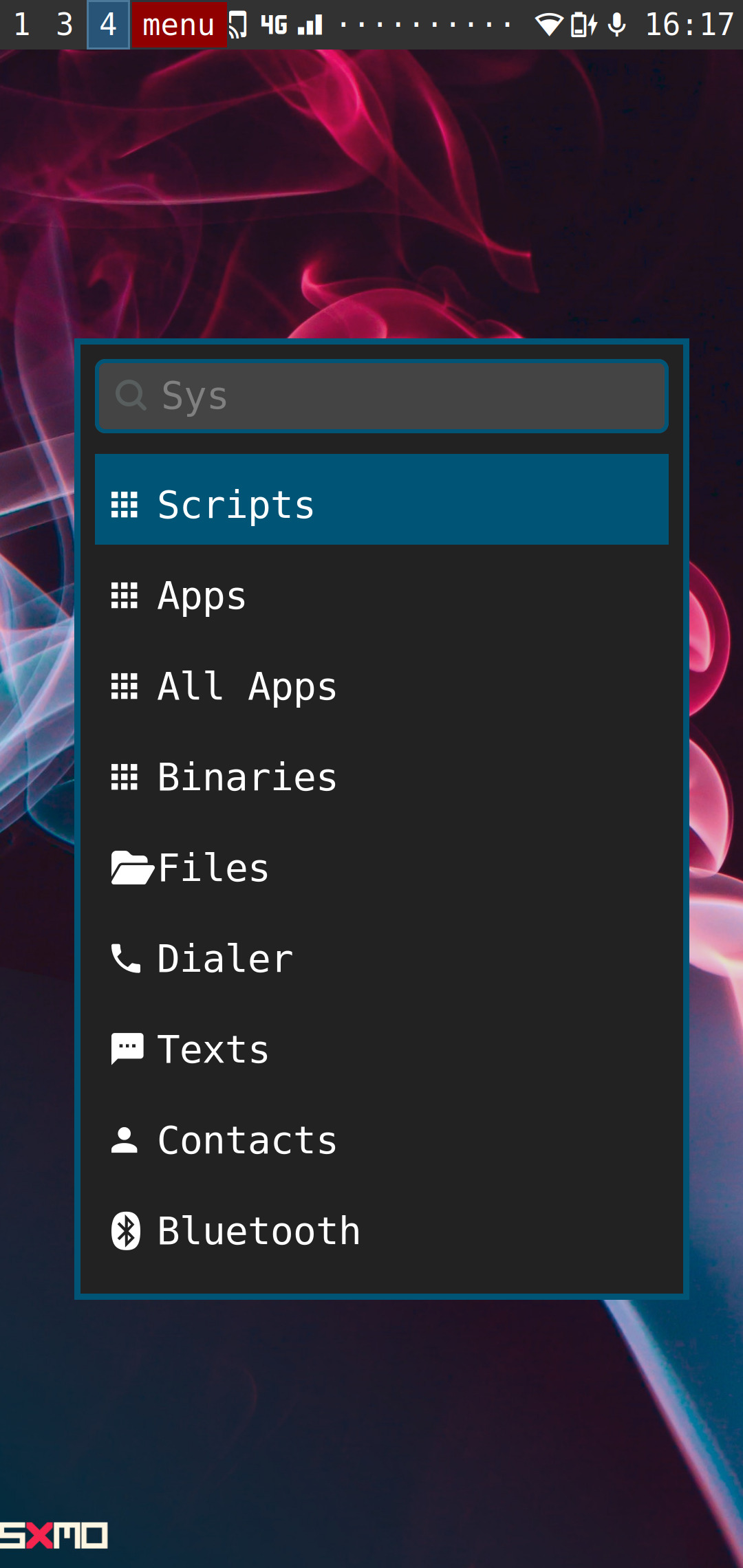
Sxmo app menu (text-searchable via dmenu/bemenu)
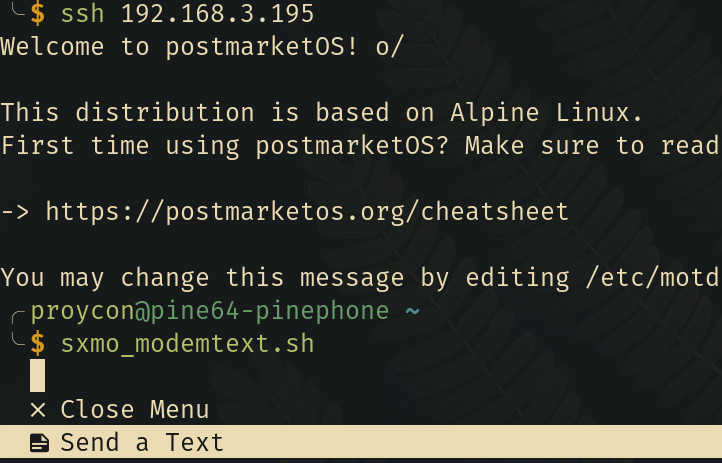
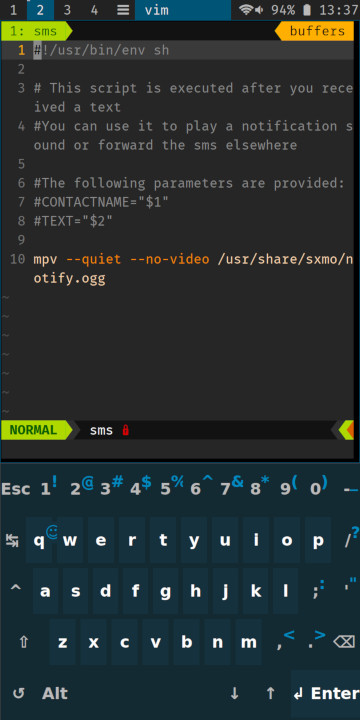

📷 Images from sxmo.org — click to view full size
What Is GNOME Mobile?
GNOME Mobile adapts the full upstream GNOME Shell for phone-sized screens using a patched version of Mutter. It uses the standard GNOME Activities Overview paradigm: swipe up to reveal the overview with dock, app grid, and workspace thumbnails. The visual design is pure GNOME Adwaita.
⚠️ Critical caveats (mid-2026): Stuck on GNOME 48 while desktop GNOME is at v50. No prebuilt images — must be built from source via pmbootstrap. Noticeably slower than Phosh on the same hardware. Occasional crashes and shell restarts. Call audio routing is completely broken (neither party can hear each other). Night light does not function. No terminal keyboard switcher.
RAM usage: Heaviest of all four UIs (~800–1200 MB idle). GNOME Shell was not designed for mobile and carries significant overhead. Purism specifically built Phosh because GNOME Shell was "too processing heavy" for phones. Community consensus: heavier than Android. Not recommended for devices under 4 GB RAM.
Version in pmOS 26.06: 48.mobile.0 · RAM: ~800–1200 MB · Status: Experimental — NOT daily-driver ready · Best for: GNOME contributors and early adopters

GNOME Shell Mobile on OnePlus 6

📷 Images via Wikimedia Commons — GNOME Mobile on actual devices. Click to view full size.
🏁 PostmarketOS: Final Verdict
🏆 Best Overall: Librem 5
Score: 44/50 (88% feature completeness)
Most working features of any pmOS device. VoLTE, camera, FDE, Signal Desktop all functional.
Hardware kill switches for privacy. The only device where pmOS is a credible daily driver phone.
Downside: Expensive ($699), modest performance, GPS unreliable, battery mediocre.
Hardware varies between units. Purism's reputation for fulfillment delays.
💰 Best Value: PinePhone
Score: 39/50 (78% feature completeness)
$150 gets you a mature, well-supported pmOS device with 6 hardware kill switches.
Most versatile device ecosystem-wide (8 Linux distros!).
Downside: Slow, poor battery, weak GPS, no front camera, video recording broken.
Not a daily driver for non-enthusiasts. Still being sold (est. 2 more years of availability).
⚡ Best Performance: OnePlus 6/6T
Score: 34/50 (68% feature completeness)
Fastest pmOS hardware available. SDM845 with Vulkan GPU support. 6–8 GB RAM.
Incredible value at ~$150 used. Amazing pocket Linux computer.
Downside: Voice calls unreliable, GPS ✗, cameras ✗, sensors ✗ on pmOS.
It's a Linux PC in your pocket, not a phone. Best paired with a separate phone for calls.
🔮 Best Upcoming: SHIFTphone 8
2024 device · QCM6490 · 12 GB RAM
Modern hardware with a company actively contributing mainline patches.
If SHIFT's track record (best SDM845 telephony) carries forward, this could
become the definitive pmOS phone within 1–2 years.
Downside: Not available yet for pmOS. Timeline uncertain.
QCM6490 mainlining is still in progress. Price likely €500+.
📋 The Honest Bottom Line (August 2026)
PostmarketOS has made astonishing progress. A daily-driver user reports the Librem 5 went from "almost nothing worked to almost everything works." The project now covers 65 devices with pre-built images and 723+ with some level of experimental support. Phosh convergence is genuinely impressive and seamless.
But: Even the best device (Librem 5, 88% feature score) has significant compromises — slow performance, unreliable GPS, mediocre battery. The second-best (PinePhone, 78%) loses 10 percentage points. The hardware gap is real: the newest SoC with mature mainline support (SDM845) is from 2018. Cameras, VoLTE, GPS navigation, and battery life remain systemic challenges across the entire ecosystem.
Who should use postmarketOS today: Linux enthusiasts, privacy maximalists, developers targeting mobile Linux, tinkerers repurposing old hardware. If you need reliable calls, banking apps, smooth navigation, or a polished app ecosystem — keep an Android/iOS phone and use pmOS as a secondary device or pocket Linux computer. The gap is closing fast, but it's not closed yet.
🗣️ What the Community Actually Says
Real quotes and experiences from postmarketOS daily-drivers in 2025–2026, gathered from forums, Lemmy, Mastodon, and personal blogs.
💬 Librem 5 Daily Driver
"I can confidently say that the Librem 5 does get better with age and, more importantly, software development."
Multiple users report daily-driving pmOS on Librem 5. "Almost everything works" in 2026 vs. "almost nothing worked" in earlier years. Battery life notably improved on pmOS edge with Phosh 51.0. Most keep a backup de-googled Android phone for GPS navigation.
💬 OnePlus 6T — One Week Trial
"I used PostmarketOS on a OP6T for a week. Needs a bit more time in the oven."
Could not make phone calls reliably. The suspend/wake-for-calls problem is the dealbreaker. Many OP6 users carry two phones: an Android OP6 + a pmOS OP6T. Data-centric tasks (SSH, coding, browsing) work great.
💬 PinePhone Realist
"I use PostmarketOS (with phosh) on a PinePhone. The modem crashes if you look at it funny... It's my daily driver, but then again, I barely use a cell phone in the first place."
Multiple users explicitly warn "Don't use it" as a daily driver. One user accepted missed calls/SMS as "a price I am willing to pay." Best for people who rarely make calls.
💬 Fairphone 5 — One Year In
"Camera is crap by Android standards — retro/underwater vibe. Calls reportedly still don't work reliably."
One user has carried it for a full year on pmOS edge. Carries a UBports phone as backup for calling. Active mainlining by Fairphone-employed developer. The fastest-improving device in the pmOS ecosystem.
⚠️ The Six Common Pain Points (All Devices)
| # | Issue | Severity | Details |
|---|---|---|---|
| 1 | Suspend/Wake for Telephony | Critical | The #1 daily-driver blocker. Most devices can't wake from deep sleep to ring for calls or receive SMS. You choose: ~1 day battery with no calls/alarms, or ~4 hours battery with wake enabled. Only Librem 5 handles this well. |
| 2 | VoLTE | Critical | As carriers globally sunset 2G/3G, VoLTE becomes mandatory for phone calls. Only Librem 5 has reliable VoLTE. OnePlus 6 has experimental support. Most other devices have none. Carrier allowlisting (blocking "unrecognized" devices from VoLTE) is a growing threat to all mobile Linux. |
| 3 | GPS / Navigation | Major | Slow lock times, no AGPS, poor turn-by-turn performance. Users consistently cite this as the reason they keep a backup Android phone. Even on Librem 5, GPS lags at driving speeds (>50 km/h). |
| 4 | Camera Quality | Major | Even on devices where camera "works," image quality is far below 2026 Android standards. libcamera Software ISP produces uncalibrated, noisy output. SDM845 camera support arrived in 2025 but quality remains poor. It's an active area of development but not solved. |
| 5 | Battery Life | Major | Even on the best devices, battery is compromised. PinePhone Pro gets ~1 hour active / 8 hours standby with NO deep sleep. PinePhone: 3–5 hours. Librem 5: ~4–5 hours active. OnePlus 6: best at 12–29 hours but at the cost of broken notifications. |
| 6 | Messaging Apps | Major | Signal works via Flatpak desktop version (awkward mobile UX). WhatsApp is a non-starter. This alone eliminates pmOS for many potential users. Waydroid helps but adds significant battery drain and SafetyNet-dependent apps still fail. |
🎯 Final Verdict: What Should You Actually Buy for postmarketOS?
| If you want... | Buy this | But know... |
|---|---|---|
| Most features working today | Librem 5 ($699–800) | Aging 3 GB RAM, slow GPU, poor battery, GPS unreliable. You'll want a backup phone for navigation. |
| Best performance / value | OnePlus 6/6T ($50–150 used) | Phone calls won't wake from suspend. VoLTE unreliable. Carry a backup Android phone for calls/SMS. |
| Modern hardware with a future | Fairphone 5 (2023) | No camera, no NFC, VoLTE broken. But actively maintained by paid developers. Fastest-improving device. |
| Cheapest entry point | PinePhone ($150 new) | Slow, terrible battery, unstable modem. NOT a daily driver. Great for learning/tinkering. |
| A reliable phone that respects privacy | Google Pixel + GrapheneOS | Not Linux, but the overwhelming community consensus for anyone who cannot tolerate missed calls, broken navigation, or carrying two phones. |
📝 Methodology & Sources
Research compiled August 1, 2026. Sources include: postmarketOS wiki and blog, UBports devices portal and blog, Mobian blog and Debian Wiki, Manjaro ARM forums, Sailfish OS docs and forums, Purism community forums and Crimson dev reports, Droidian docs, Kali Linux docs, PINE64 wiki, XDA Developers, The Register, DistroWatch, SitePoint, LWN.net, and community reports from Lemmy, Fosstodon, and Reddit (r/postmarketOS, r/linuxphones, r/PinePhone, r/UBports).
⚠️ Disclaimer: Mobile Linux is a fast-moving target. Port statuses change weekly. Kernel regressions break and fix things unpredictably. Always check the latest device wiki pages and forums before flashing. This page was last updated August 2026.